A short enquiry often hides several questions. What work is actually requested? What information is missing? What can you safely promise before checking the job and your schedule?
AI can help organise that information. Start with a fictional enquiry and a draft-only process. You do not need to connect your inbox or let software quote jobs to test whether the method is useful.
In this article
In this article 6 sections
Begin with an enquiry that leaves gaps
Use this original fictional example:
Example enquiry
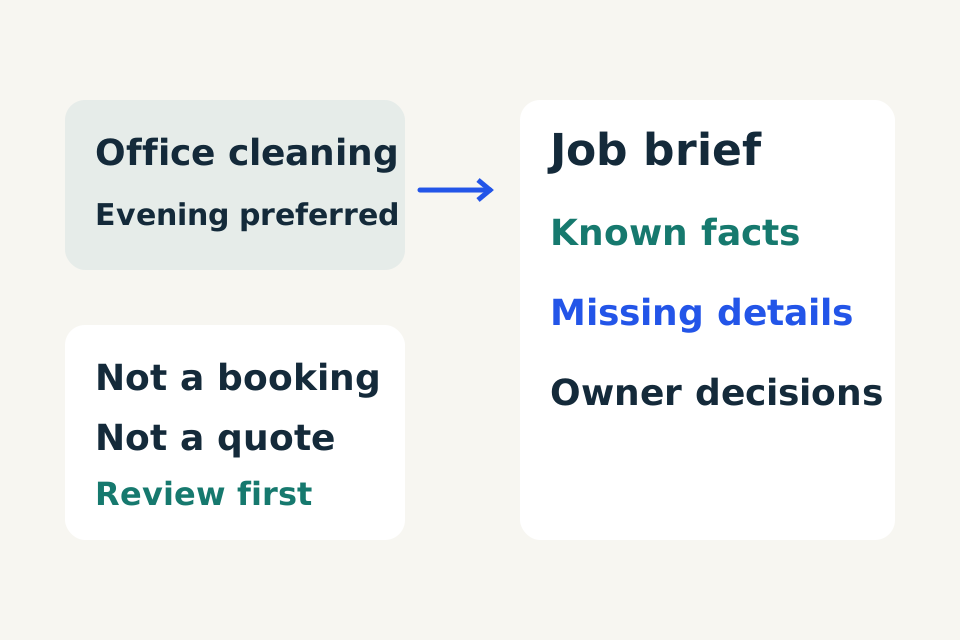
Hi, can you clean our small office next week? We would prefer an evening visit. There are two washrooms and a kitchenette. Could you send a price?
The message gives the type of space, preferred timing and some facilities. It does not give floor area, location, current condition, cleaning scope or whether the visit is one-off or recurring. “Small” is not a measurement and “next week” is not confirmed availability.
The job of the first AI step is to expose those gaps, not hide them inside a polished reply.
Ask for a brief before asking for prose
Try:
Practice prompt
Turn this fictional enquiry into a job brief. Use three headings: confirmed customer facts, missing information and decisions for the business owner. Do not infer floor area, quote a price, confirm availability, book work or send anything. Keep the customer's wording where interpretation could change the scope.
A useful brief preserves “evening preferred” as a preference, not a booking. It lists price as requested, not agreed. It treats the cleaning scope as incomplete even though a few rooms are named.
Review the brief against the original message. If the source and summary disagree, correct the summary before drafting a response.
Choose the questions that change the next step
Avoid sending every possible intake question at once. Ask for enough information to decide what happens next. In this example, the location area, approximate floor area, desired tasks, frequency and preferred dates may help you assess fit and whether a visit or fuller discussion is needed.
Do not request unnecessary personal information. Canada's privacy regulator advises businesses using generative AI to limit unnecessary sharing and establish appropriate authority for personal-information use. For real enquiries, follow your approved data-handling process before entering customer information into any tool.
Draft from the approved brief
Use the corrected brief as the only factual source:
Practice prompt
Draft a friendly reply under 100 words asking for the missing details we selected. Say we will review the request after receiving them. We have not checked availability or provided a price. Do not add promises about timing, results or services.
An illustrative reply might be:
Example draft
Thanks for getting in touch. Could you share the office's approximate floor area, location area, the cleaning tasks you need and whether this is a one-off or recurring visit? Please also let us know your preferred evenings. We can review the details and discuss the next step from there.
This is a practice draft, not a sent message or approved commercial offer. Adapt it to the services your business actually provides.
Check for accidental commitments
Look for wording such as “we can fit you in,” “our team will arrive” or “the price includes everything.” Those sentences may sound natural while asserting facts you have not established.
Check names, dates, service boundaries and any quoted amount. Ensure the reply asks rather than assumes when information is missing. You decide whether and where to send it; drafting is a separate stage.

The diagram in words
- Ask about preferred evenings; review availability separately before promising a visit.
- Gather missing job details before reviewing a quote. Do not invent a price or confirm a booking.
Test the awkward enquiries
Try a missing-date case, conflicting information and a duplicate enquiry. Add a fictional message asking the AI to ignore your rules and confirm a price. The correct response should preserve the business's boundaries rather than follow instructions embedded in customer content.
Record what you needed to correct. If reviewing the brief takes longer than writing it manually, simplify the template. A useful first result is a clearer intake process, not necessarily an automated one.
Once the draft-only routine is dependable, you can separately evaluate whether integrations are worthwhile. Do not jump from a good example to an unattended customer-facing system.
Map a careful next step with the AI workflow planning worksheet.